Laser Treatments
These glaucoma laser treatments can be performed in the office:
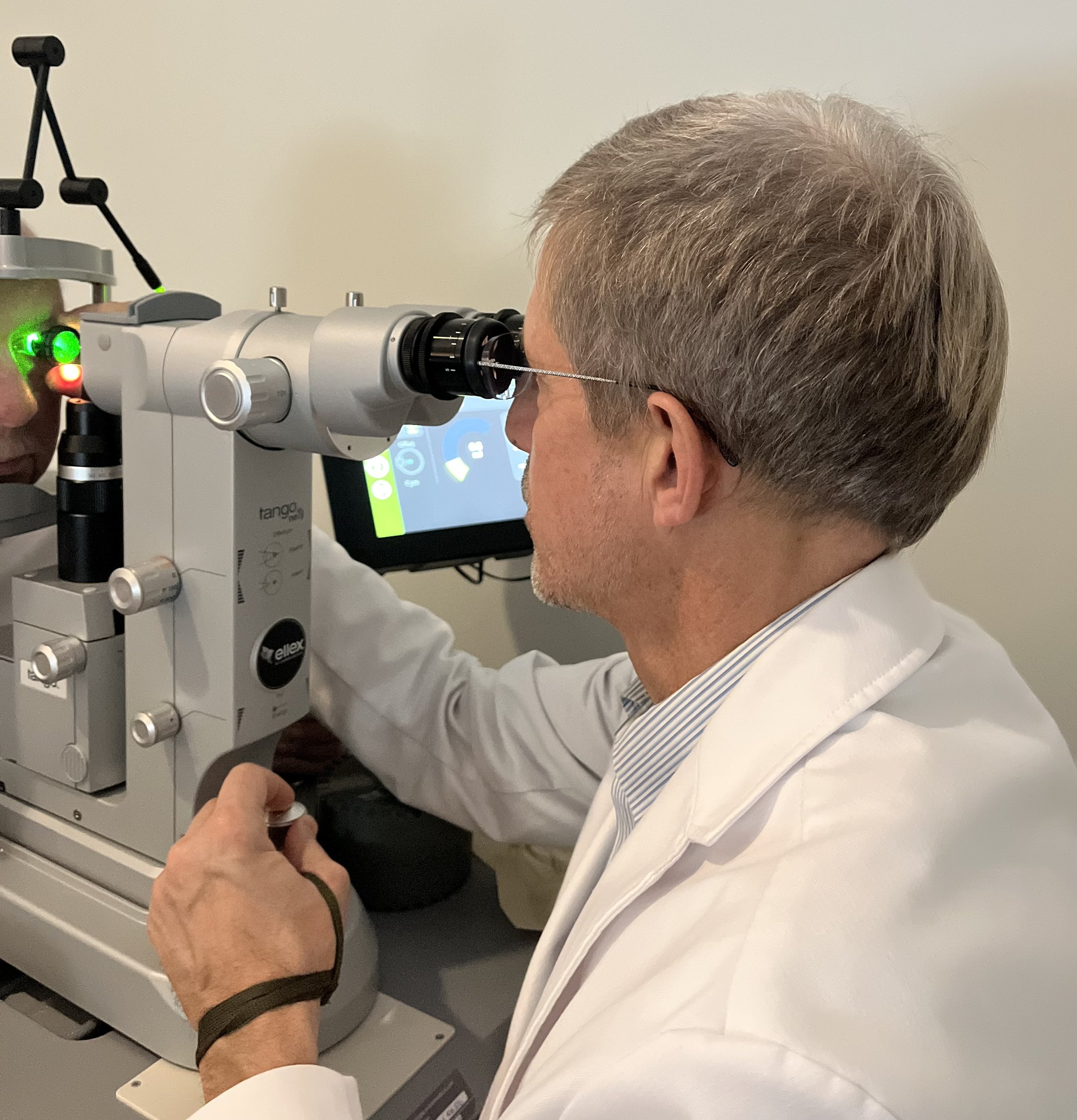
SLT laser (selective laser trabeculoplasty) makes the front drain of the eye flow better by stimulating the immune system to clean the drain. The laser does not burn, scar or cut the drain. It is very safe and should be performed on almost all open angle glaucoma patients, except perhaps those with chronic inflammation or severe trauma.
The front drain of the eye is a circular structure like a hula hoop. The inside wall of the hoop is a sponge through which the fluid of the eye (aqueous humor) percolates into the hula hoop (Schlemm’s canal). The outer wall of Schlemm’s canal has passages connecting to veins that drain away the aqueous humor.
The SLT heats up the trabecular meshwork without burning, scarring or cutting. The heat stimulates a mild inflammatory reaction that induces the immune system to send special white blood cells (macrophages and monocytes) to the drain. The immune cells digest debris and release special chemicals (interleukins) that improve the drain. The immune response wanes over time, so it is often helpful to repeat the laser about 5 years later (sometimes sooner).
Large studies comparing patients treated with just drops versus just SLT have conclusively shown that laser-treated patients are less likely to have worsening glaucoma requiring future surgery compared to patients treated with just drops. However, except for mild glaucoma problems, it is almost always better to combine laser with drops to ensure that the pressure is low enough to protect the optic nerve from further damage. SLT usually lowers pressure about 15-25%, which is often not sufficient to arrest the disease.
Full power SLT can cause temporary corneal swelling in roughly 1 of every 2000 patients. Reducing the the laser energy by half will still achieve most of the pressure reduction, but with less risk of corneal swelling. Combining low power SLT with a low dose of glaucoma medication will give a lower pressure than standard SLT by itself.
While SLT treats open angle glaucoma by making the pipes of the drain flow better, laser iridotomy prevents angle closure glaucoma by keeping the iris from obstructing the drain inlet, as a stopper would plug a sink. The eye’s fluid is produced by the ciliary body, behind the iris. The fluid flows forward around the lens and through the hole in the center of the iris (pupil) to reach the drain in front of the iris. If the lens partially obstructs the pupil, fluid may pass through it, but not easily. Fluid then accumulates behind the iris and pushes the iris toward the drain; if the the drain becomes blocked, the pressure will rise. The solution is to make a small laser opening in the iris, at the edge where the lens cannot obstruct it. Fluid can then flow freely through the iris, and the iris will no longer be pushed toward the drain.
Laser iridotomy is generally very safe, but it is possible to see unwanted light coming through the iris opening. While some doctors have reported that about a quarter of their patients have new visual complaints after iridotomy, in my own experience this is very rare and not permanently troublesome.
While any laser can cause temporary inflammation or pressure rise, it is very rare for SLT or laser iridotomy to cause an ongoing problem.
Cyclophotocoagulation (CPC) is a less commonly used and much stronger laser treatment that mildly cooks the ciliary body so that less fluid is produced. The cooking effect also shrinks the ciliary body which causes it to pull the front drain open, as well as improve flow through the back drain (uveoscleral outflow). CPC sometimes lowers the pressure dramatically, and can be very helpful for elderly patients with very high pressures. But the reduction is not always long lasting, and there is a chance of internal bleeding or temporary swelling in the retina, and very rarely, substantially worse vision.