CATARACT SURGERY
With age, the lenses of our eyes become cloudy: a cloudy lens is called a cataract. Cataract surgery is essentially lens replacement — the cloudy lens is replaced by a clear plastic lens implant. Cataract surgery is usually performed when the patient develops unacceptable driving glare or general blurriness not correctable with glasses.
Cataract surgery is a necessary component of many glaucoma surgeries because the natural lens can crowd the drain that keeps eye pressure down. Patients with pseudoexfoliation glaucoma often have cataracts which are more difficult to remove, so glaucoma surgeons are experienced in challenging cataract surgeries.
TYPES of LENS IMPLANTS
After cataract surgery, most patients will use reading glasses for close vision while having not much need for distance glasses. Almost all patients will see slightly better with distance glasses but only about 1 in 20 will need to wear distance glasses most of the time.
MONOFOCAL lenses focus at one particular distance; glasses are needed to see closer (or further) than that distance). Monofocal lenses give the most vivid vision with the least glare, but glasses are often useful to get the best focus. Monofocal implants are covered by insurance.
MULTIFOCAL lens implants are not covered by insurance. They improve the ability to see clearly both near and far without glasses, but compared to monofocal lenses they have more glare and less contrast (the ability to see for example a white line on the edge of the road while driving in rain). The reduced contrast and increased glare cannot be improved by glasses. The loss of contrast can be an increasing problem later in life if there is substantial glaucoma damage or retinal disease such as macular degeneration or epiretinal membrane. Even aging can make contrast loss more of a problem, so Dr. Libre generally advises against multifocal lenses; however, many excellent doctors believe that they benefit their patients.
MONOVISION means that one eye sees far and the other sees close, reducing the need for glasses to change the focus. However, a large focal length difference between the eyes can be frustrating because it is harder to use the eyes together and depth perception is reduced. However, making one eye focussed just slightly closer than the other (mini-monovision) will reduce the dependence upon reading glasses without causing noticeable difficulty using the eyes together. Dr. Libre recommends this for most patients. The typical result is that patients after cataract surgery can read texts on the phone and larger print reading material, but will use reading glasses for smaller print and reading more than a few minutes.
TORIC lenses correct astigmatism or corneal warpage. Toric lenses are warped implants which counteract the warpage of the cornea. Like multifocal lenses, toric lenses are not covered by insurance. Unlike multifocal lenses, they do not reduce contrast or increase glare. Another option for correcting astigmatism without a toric lens, is to change the location and number of incisions in order to reduce the warpage of the cornea. Dr. Libre often recommends this for astigmatic patients.
The LIGHT ADJUSTABLE LENS (LAL) is an implant which can be fine-tuned by ultraviolet light several weeks after surgery. LAL patients will usually end up with less astigmatism and more precisely corrected mini-monovision, so they tend to see better without glasses than patients with traditional implants. There is usually no loss of contrast or increased glare as would be expected with multifocal lenses. While they are less likely to use glasses, LAL patients will always see a little better with some additional corrective glasses for near or far. Disadvantages of the LAL: it costs $2500/eye; 3-5 additional postoperative visits are needed to adjust the implant; to prevent sunlight from causing random adjustments, special sunglasses are used outdoors until the adjustments are completed; the UV adjusting light is uncomfortably bright for some patients and probably better avoided for people with a family history of macular degeneration.
Femtosecond laser can be used for some steps of cataract surgery, but most studies have found that the laser does not significantly improve outcomes for most patients.
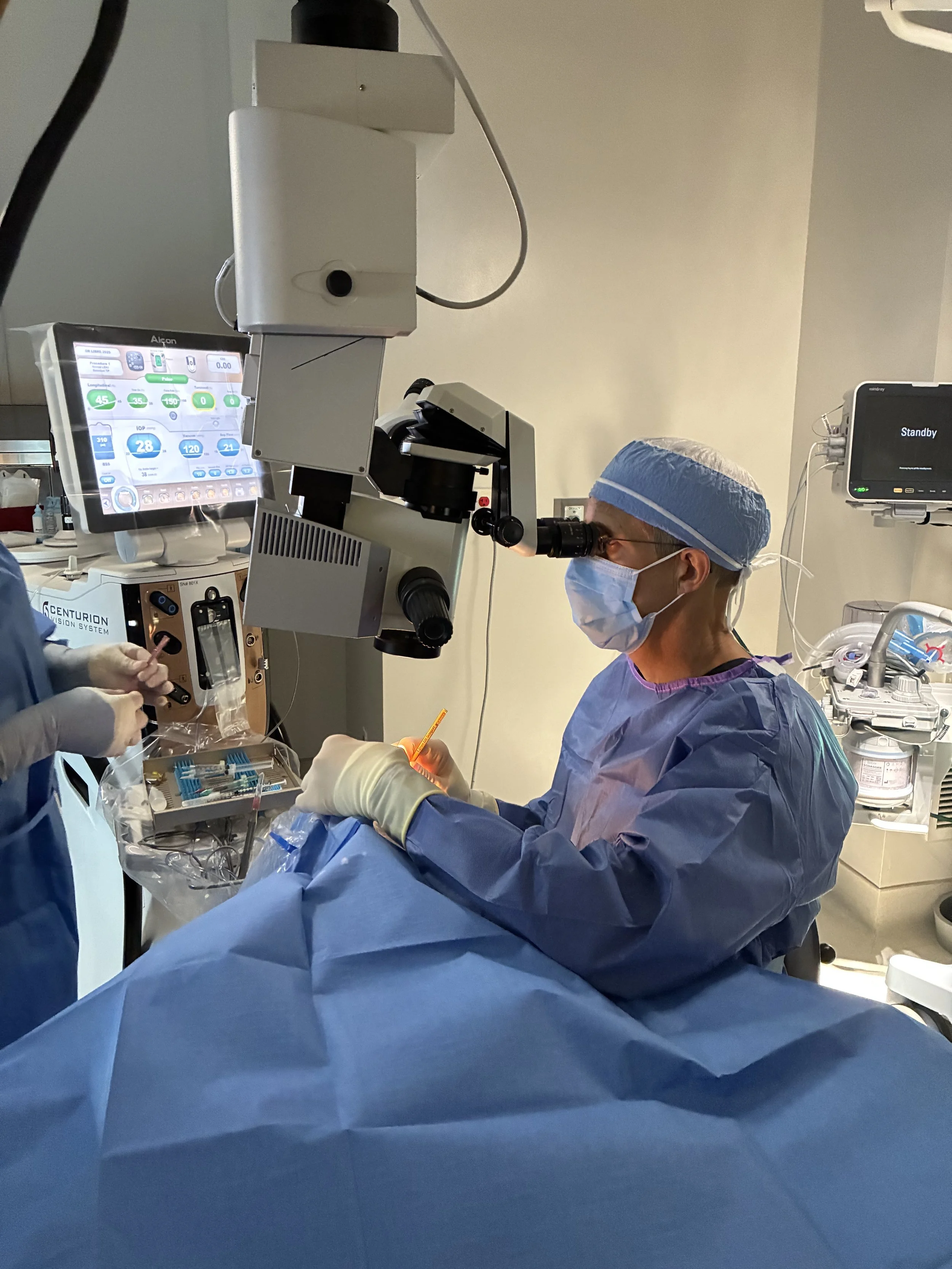
LASER CAPSULOTOMY after CATARACT SURGERY
About 1/3 of cataract patients eventually need a YAG laser capsulotomy to open a cloudy membrane behind the lens implant, months or years after surgery. The natural lens of the eye is surrounded by a membrane about as thick and strong as cellophane. During surgery, an opening is made in the front layer of the membrane, the internal cloudy contents are removed, and the plastic implant is placed inside the membranous sack. After surgery, the vision may become cloudy because cells migrate across the part of the membrane behind the implant. This is easily and safely fixed in the office by using a laser to make an opening in the membrane.
RISKS & BENEFITS of CATARACT SURGERY
One in several thousand patients will probably see much worse after cataract surgery, and one in several hundred will probably see slightly worse. On the other hand, an unoperated cataract will usually become slightly worse in a few years and a lot worse in 5-10 years.
It is now proven that unoperated cataracts make stumbles and fractures likelier; it is estimated that 7 cataract surgeries will prevent one fracture. It is also known that unoperated cataracts increase the risk of dementia, because poor vision slows down reading and limits getting out to be with other people.
There is no option with zero risk: cataract surgery has some risk and living with cataracts also has some risk. When the cataract is substantially cloudy, the probable benefits of better vision outweigh the risk of cataract surgery.
WHAT CAUSES CATARACTS?
Very healthy people will need cataract surgery in their 80s, from normal aging.
Patients with a few well-controlled medical problems will usually need cataract surgery in their 70s.
Patients who need cataract surgery in their 50s and 60s have often been smoking, overweight, inactive, diabetic, eating too few fruits and vegetables and too much processed carbohydrate (alcohol, white flour/rice/corn). I advise about 6 fruits and vegetables per day, 2 with each meal. Whole grains are much healthier than rice or flour that has been enriched: enriched means it was first depleted of its outer covering, so it will raise your blood sugar quickly. Delicious breakfast porridge can be made easily from buckwheat, oats, quinoa, or corn meal; barley, teff, farrow, brown rice, wild rice make great sides at dinner. Seeds and nuts are important. Be sure to eat some fish. There are no 10 or 15 super foods: eat a wide variety of plants, whatever is in season, preferably organic. Dandelions, pumpkins and wild onions are easy to grow in your own yard. Supplements are generally useless compared to to eating real food. One soda or fast food sweet drink per day is sufficient to ruin your health.
Strong sun makes cataracts (and macular degeneration) likelier, so sunglasses are a good idea. They don’t have to be expensive.